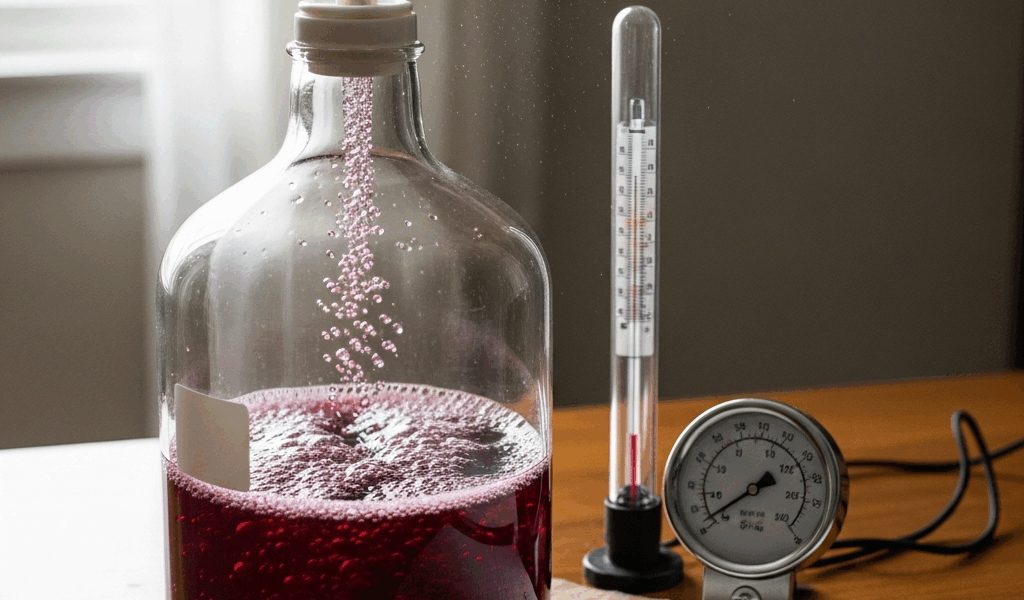
Homemade Wine Won’t Stop Fermenting — Fix It Fast
Home winemaking has gotten complicated with all the conflicting advice flying around.
Most troubleshooting guides fixate on the opposite problem — stuck fermentation that won’t start. But there’s a whole other category that gets quietly ignored: wine that ferments too aggressively and simply won’t quit. It happens more often than people admit. And it’s fixable.
Why Is Your Wine Still Fermenting
Four scenarios land you here.
First: you over-pitched yeast. Too much starter culture, or pitched at too high a concentration. The yeast population is enormous. Still hungry. Still working.
Second: your yeast strain is a workhorse. EC-1118 — or anything marketed for “complete fermentation” — is specifically designed to consume nearly every available sugar molecule. You picked a machine and it’s doing exactly what it was built to do.
Third: residual sugar is still present. Maybe you added fruit late, or your initial gravity was higher than you calculated. The yeast hasn’t actually finished. It just looks like it should have.
Fourth: temperature. Yeast sitting at 75°F ferments faster and longer than yeast at 68°F. A vessel near a heat source — or sitting in summer conditions — will keep pushing activity for days longer than expected.
Most of the time it’s a combination. Diagnosis comes next.
First Check — Is It Actually Still Fermenting
This reality check alone saves arguments and bad decisions.
Airlock bubbling is not your friend here. A bubbling airlock means gas is moving through it — at least that much is true. But that gas could be active CO₂ from live fermentation, or it could be CO₂ slowly off-gassing from a batch that finished two days ago. You genuinely cannot tell by watching bubbles. I watched bubbles for a week once and made completely the wrong call.
The hydrometer is what matters. Full stop.
Take a gravity reading today. Write it down — pen and paper, phone notes, whatever. Wait 48 hours. Take another reading under identical conditions, same room temperature, same time of day if possible. Identical readings mean fermentation has stopped. A gravity that keeps dropping means yeast is still working.
That’s the only test that counts. Skip the airlock theater entirely.
A finished dry wine typically falls between 0.990 and 0.998, depending on starting gravity and yeast strain. Sweet wines finish higher — 1.005 to 1.010 or beyond. But if you’re searching this topic at midnight, you probably didn’t plan on sweet wine.
How to Stop Fermentation Without Ruining the Wine
Three options exist. Pick one based on your timeline and how much equipment you actually own.
Cold Crashing — The Easy First Step
Lower your fermentation vessel to 35–40°F and hold it there for five to seven days. Don’t freeze it. Just make it genuinely cold.
A basement wine fridge works. A garage in January works. I’ve used a spare Frigidaire set to its lowest dial position — ran around 38°F, confirmed with a cheap thermometer from the hardware store.
Cold doesn’t kill yeast. It slows yeast metabolism dramatically, sending cells dormant. Fermentation activity drops fast. Many home winemakers find the yeast simply never re-activates when the carboy returns to room temperature.
Take a gravity reading before cold crashing and again after the cold period ends. No drop means you’ve bought real time.
Stabilization with Sorbate and Sulfite — The Real Solution
Probably should have opened with this section, honestly.
Potassium sorbate stops fermentation — but only when paired with potassium metabisulfite. That pairing is critical and almost nobody emphasizes it clearly enough.
Sorbate alone prevents re-fermentation, meaning yeast won’t restart after stabilization. It does not stop active fermentation already in progress. That distinction matters enormously. People use sorbate solo and then watch their bottles detonate two weeks later. Don’t make my mistake.
The combination works like this: metabisulfite stuns or kills the yeast population. Sorbate prevents any survivors from re-fermenting down the road. Together they’re reliable.
For a standard five-gallon batch, use:
- 1/2 teaspoon potassium metabisulfite — dissolved in a small amount of warm water first
- 1/2 teaspoon potassium sorbate — dissolved separately in water before adding
Stir both into the carboy. Wait 24 hours. Take a gravity reading. Check again at 48 hours. No further gravity drop means you’re stabilized. The wine tastes normal — no off-flavors, no chemical weirdness. Yeast is simply no longer viable. Bottling within a week is safe.
Sterile Filtration — Only If You Have the Equipment
A 0.45-micron sterile filter physically removes yeast cells from suspension. If you already own a home filtration setup, this works cleanly and completely. Most casual winemakers don’t own one — and honestly shouldn’t rush out to buy one just for this.
It costs more than sorbate plus sulfite combined. Skip it unless the equipment is already sitting on your shelf.
What Happens If You Bottle Too Early
Bottle bombs are real. Not theoretical. Actually real.
Active yeast plus residual sugar inside a sealed bottle keeps producing CO₂. Pressure builds steadily. A standard wine bottle handles roughly 4–5 psi from normal bottle conditioning — manageable. Uncontrolled fermentation in a sealed container? Accounts I’ve read describe 20-plus psi building up before something gives.
The cork blows out violently. The bottle cracks. Or it holds until you open it and wine launches across the room.
I’m apparently the type who learns from other people’s disasters, and a friend with capped homebrew bottles once described watching caps pop off on their own — wine bubbling and leaking like a science fair volcano. His words. His garage floor.
If you’re uncertain whether your batch is truly done, place a freshly capped bottle in a basement corner or on a garage shelf and check it daily for 10 days. Pressure building means you’ll see it immediately. Cap sitting flush, no swelling, no seepage — you’re likely okay. Don’t skip this step when you’re in doubt.
When to Just Let It Finish
Here’s the honest part. If your gravity sits around 0.995 and it was 0.996 two days ago, the wine is almost done. Not stuck. Not runaway. Just finishing.
Patience works.
If you don’t need the wine for another three weeks — and don’t need it stable right now — let the yeast finish naturally. Gravity will stabilize on its own. The wine will drop clear. You’ll end up with a naturally finished product that tastes exactly like it should, without any intervention.
So, without further ado, here’s the summary you actually need: cold crashing handles a lot of situations simply. Sorbate plus sulfite handles the rest reliably. And sometimes a few extra days of leaving the carboy alone is the real answer. Your first few batches teach more than any article can.
Your wine is going to be fine.

Stay in the loop
Get the latest winemaker's friend updates delivered to your inbox.