What Flat Wine Actually Tastes Like
Homemade wine has gotten complicated with all the conflicting advice flying around.
My first real lesson came from a batch of elderflower wine — three months in the carboy, clearing beautifully, looking exactly like it was supposed to. Then I cracked open a bottle. Drinkable. Not spoiled. But utterly lifeless. Like grape juice that fermented but forgot to become something worth drinking. That was 2019, and I still think about that batch.
But what is flat wine, exactly? In essence, it’s wine that lacks brightness — even when it isn’t sweet. But it’s much more than that. Flat wine coats your mouth and leaves nothing behind. No snap. No sparkle. No reason to pour a second glass. People describe it as muted, muffled, one-dimensional — like someone turned the volume all the way down on whatever fruit you started with.
This is completely different from young wine tasting tannic or harsh. Young wine often has too much acidity. Flat wine has too little. Opposite problems, opposite solutions — mixing them up wastes entire batches. If your wine makes your cheeks pucker and your mouth feel dry, that’s youth and tannin talking. If it tastes soft, rounded, and somehow boring despite tasting like the fruit you used? Low acidity is almost certainly your culprit.
Why Homemade Wine Ends Up Low in Acid
Overripe fruit is the biggest offender. As fruit ripens, sugars climb — but acidity actually drops. Winemakers chasing higher alcohol sometimes pick their fruit too late, and the juice starts fermentation with half the acidity it should have. I’ve done this with plums. Don’t make my mistake.
Certain varieties are naturally low-acid to begin with. Peaches, apricots, pears, elderflower — these almost always need acid adjustment from day one. Warm-region white grapes can struggle too. If you’re starting with mild fruit, the odds of ending up flat are high. That’s just the math of it.
Water dilution sneaks up on people. Adding too much to stretch a small harvest or adjust sugar levels thins not just the fruit — it dilutes the acid that came with it. Warm fermentation temperatures compound this, speeding yeast activity in ways that burn through available acid faster than cooler ferments do.
Skipping the must test entirely is probably the most common issue, honestly. Most home winemakers never check acidity before fermentation starts. By the time the wine is finished, the window to prevent the problem has long closed.
How to Test Your Wine’s Acidity at Home
Probably should have opened with this section, honestly. Knowing your actual TA number before adding anything saves you from over-correcting — which is its own disaster.
So, without further ado, let’s dive in. Two methods exist, and one is so much better than the other it’s almost not worth explaining the second one.
A titration kit is the accurate route — at least if you want a real number to work with. A basic kit runs about $12 to $15. The LaMotte or Accuvin models both work fine. You measure a fixed amount of wine, add drops of the indicator solution until the color shifts from colorless to pink, count the drops, and do the simple math printed right on the instruction sheet. Five minutes, start to finish. Your result is a TA percentage. Most table wines should land between 0.55% and 0.75% TA. Reds can push toward 0.80%. Anything below 0.50% will taste noticeably flat. A Milwaukee MW102 pH meter works too, but it costs around $85 and needs calibration every session.
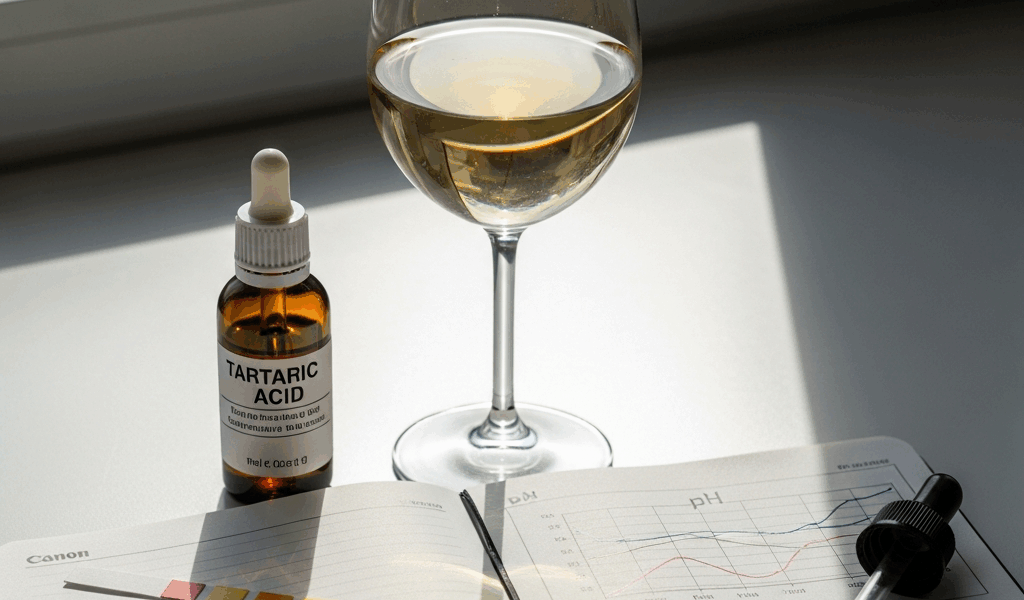
The taste-and-compare method exists if you refuse to buy a kit. Pull three identical glasses. Pour your wine into one. Into the second, dissolve roughly 1/16 of a teaspoon of tartaric acid in a splash of water and add it. Stir, wait two minutes, taste both back-to-back. Does the second glass taste noticeably brighter? More alive? If yes, your wine needs acid. The problem is you can’t measure precisely how much to add. You’re flying by feel, which is slower and riskier — especially for larger batches where a miscalculation costs real money.
How to Add Acid to Fix a Flat Wine
Start conservatively. Full stop. That’s the rule separating successful fixes from ruined batches.
While you won’t need a full chemistry lab, you will need a handful of supplies — tartaric acid powder, a small scale, and a measuring syringe. Tartaric acid might be the best option, as homemade wine requires a gentler acid correction than a sharp one. That is because tartaric integrates more smoothly than citric and doesn’t leave that artificial bite behind. A commercial acid blend — typically tartaric, citric, and malic in proportions mimicking grape wine — works well too.
Dissolve your acid in about half a cup of the wine first. Stir it until fully dissolved. Add that solution to the whole batch — not the powder directly. A typical starting dose is 1/4 teaspoon of tartaric acid per gallon. That’s roughly 0.10% to 0.15% TA increase. Sounds tiny. It’s enough to notice.
Let it sit 24 hours. The acidity integrates and settles during that window. Taste it after — ideally against a wine you know is balanced. Better? Brighter? If you still can’t feel a difference, add another 1/4 teaspoon per gallon. Wait another full day. Test again. Repeat until it’s right.
I’m apparently impatient by nature, and dumping in a full half-teaspoon at once never works for me while the slow approach always does. I’ve watched people skip the waiting. Their wine goes lip-puckeringly sour, and then they’re stuck balancing it with sugar they don’t want — and the result tastes like hard candy. Over-acidified wine is considerably harder to fix than under-acidified wine. Take the extra day.
Citric acid is a last resort. It works in a pinch, but it leaves a sharper, more artificial finish. Malic acid sits in the middle — softer than citric, more forgiving than tartaric in some blends, though harder to source alone. Most homebrew shops carry tartaric in 1-pound bags for around $6 to $8. Start there.
Preventing Low Acidity in Your Next Batch
Test your must before fermentation starts. Spend the $12 on a kit. Use it every single batch. You’ll know whether you’re starting from a deficit — and if you are, you can add acid before the yeast ever touches it. That single step cuts flat-wine problems dramatically among home winemakers who actually adopt it.
Adjust your fruit-to-water ratios if you’re stretching a small harvest. More juice in the must means more natural acid. Aim for a starting TA between 0.60% and 0.70% before fermentation begins, knowing it will drop slightly during the process.
Frustrated by consistently flat results despite using fresh fruit, I eventually started adding acid blend at the very start when working with peaches or pears — using a kitchen scale, a 4-gram addition per 5-gallon batch, dissolved in warm water before pitching the yeast. That new habit took hold after just two batches and eventually evolved into the standard approach home winemakers using naturally low-acid fruit know and rely on today. Elderflower, dandelion, and other flower wines almost always need this treatment. Without it, you get floral soup — sweet, one-note, and boring.
Testing, adjusting, tasting: it becomes routine fast. Your next batch will taste brighter, livelier, more like wine and less like fermented juice that never quite woke up.


Stay in the loop
Get the latest winemaker's friend updates delivered to your inbox.