This article includes affiliate links. We may earn a commission at no extra cost to you.
How to Test Alcohol Content in Homemade Wine — Methods That Work
Home winemaking has gotten complicated with all the conflicting advice flying around. amazon.com/SOLIGT-Triple-Scale-Hydrometer-Kombucha-ABV/dp/B07KPDF84Q?tag=winemakersfriend-20″ target=”_blank” rel=”nofollow noopener”>hydrometer.
My first real batch was three weeks of blackberry fermentation. I tasted it, decided it wasn’t grape juice anymore, and called it done. Terrible system. What I actually needed were numbers — real ones, not “yeah, this seems boozy enough” guesses.
Turns out, knowing your ABV tells you when fermentation is actually finished. It explains what went sideways with a batch. It’s genuinely useful process data — not trivia. And depending on your state or country, it might matter legally if you’re handing bottles to friends.
I’ve run hundreds of samples through four different methods over the years. Some cost almost nothing. Some cost embarrassingly more than they probably should. Here’s what actually holds up in a real home setup.
The Hydrometer Method — Simple but Approximate
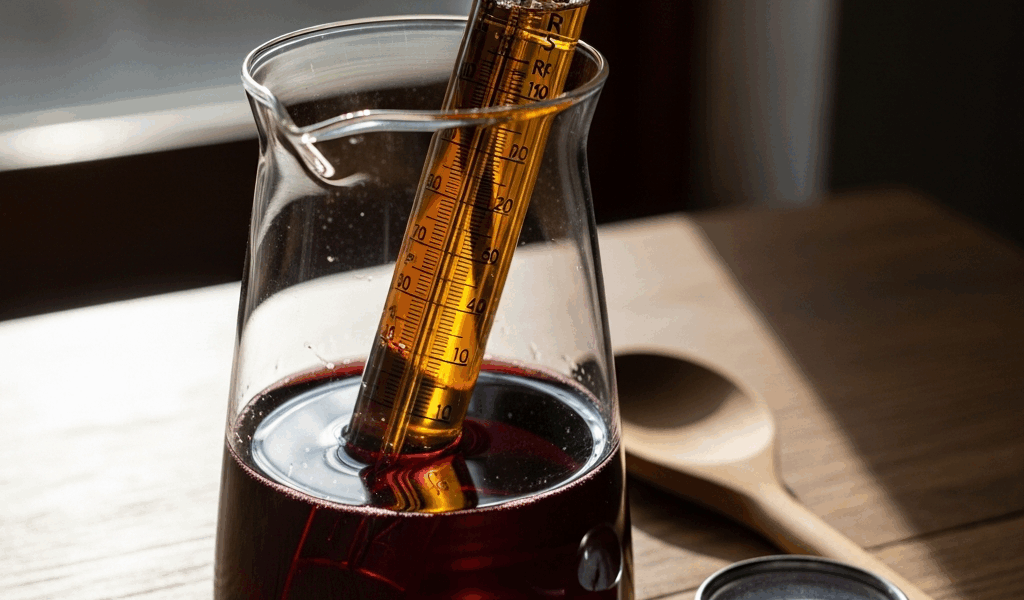
But what is a hydrometer? In essence, it’s a weighted glass tube that floats in liquid and measures specific gravity. But it’s much more than that — it’s the backbone of home fermentation tracking, and honestly, it’s where every winemaker I’ve ever met started.
You can grab one for $8 to $25. Simple physics. The tube sinks lower in denser liquids, higher in lighter ones. As your yeast eats sugar and produces alcohol, the liquid gets lighter — and your hydrometer sinks deeper.
The math isn’t scary: take your Original Gravity reading before fermentation, subtract the Final Gravity reading after fermentation ends, multiply by 131.25. Done. That’s your ABV.
Concrete example — my Riesling batch last spring. OG landed at 1.090. FG stabilized at 1.005. Run that through the formula: (1.090 − 1.005) × 131.25 = 11.2% ABV. The hydrometer told me we were finished when 1.005 held steady across two consecutive days.
Accuracy sits within plus or minus 0.5% — more than adequate for any home operation.
Here’s the catch that actually matters: you have to pull that OG reading before fermentation starts. Sounds obvious. Isn’t. I forgot twice. The second time stung worse because I already knew better.
Forgot your OG? You have options — not great ones, but they exist. Estimate from your recipe ingredients and compare against notes from previous batches with similar starting points. Use a refractometer to work backwards, though the accuracy drops off. Or accept this batch as a measurement mystery and taste your way through it like a medieval peasant. Your call.
Temperature matters more than people admit. Most hydrometers calibrate to 60°F. Warmer wine reads artificially low; colder reads artificially high. For rough home purposes, this usually doesn’t derail anything — but serious winemakers keep correction charts nearby. A clean sample tube is non-negotiable. Pull your sample straight from the carboy. Don’t guess.
Refractometer Method — Quick but Needs Correction
I bought my refractometer fully convinced I’d retire the hydrometer. That was naive — apparently a recurring theme for me.
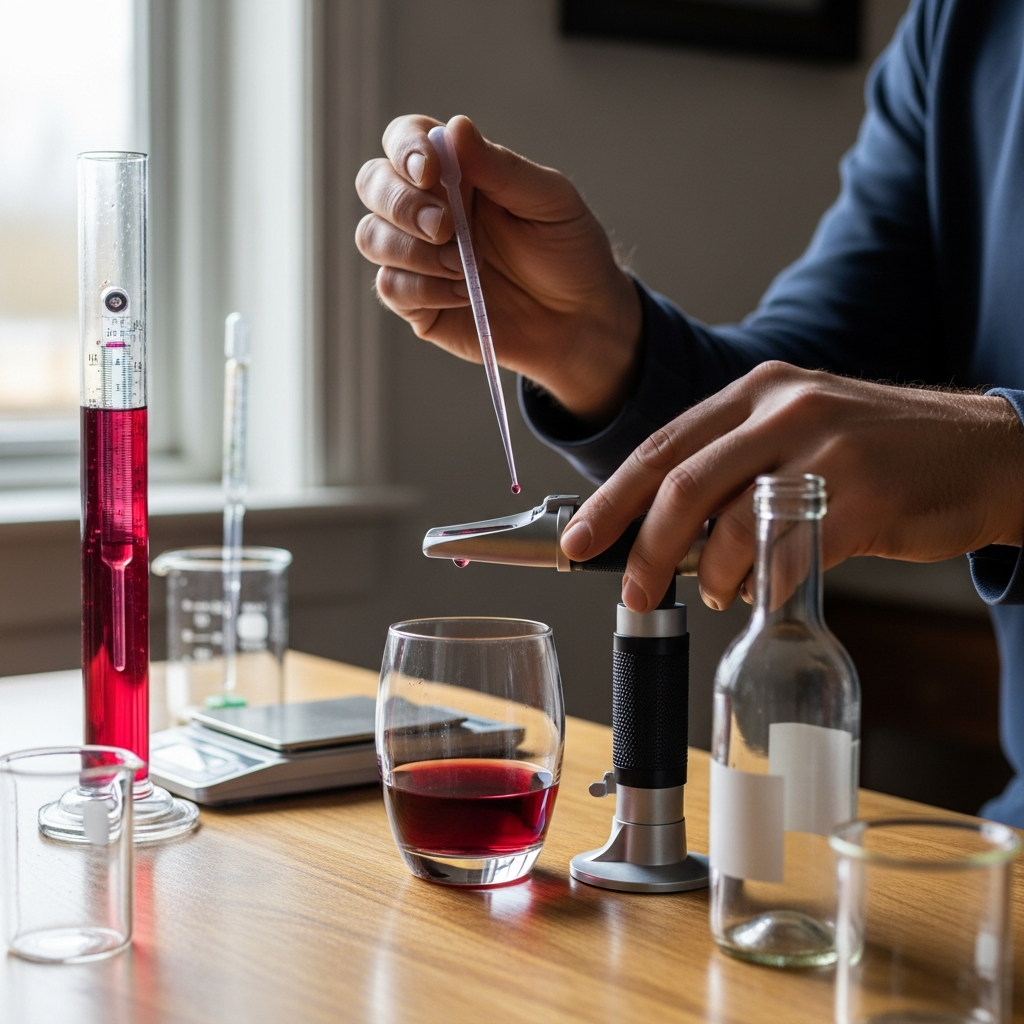
Refractometers measure how light bends through liquid. They run $30 to $80 for a decent unit — more expensive — but the sample size is absurd: one drop. Revolutionary, honestly, compared to needing half a cup of wine for a hydrometer reading.
The problem is physics. Once fermentation starts, alcohol and residual sugars bend light differently than plain water does. Your readings become essentially meaningless without a correction formula applied on top.
Winemakers use something called the Nico Bauer formula — or similar variants — to adjust readings during active fermentation. The algebra is genuinely ugly. I gave up doing it by hand and just run my numbers through an online calculator instead. The wineoninternet.com calculator has worked reliably for me. No shame in it.
Quick day-seven sanity check? One drop, two seconds, you’re done. It’s a supplementary tool. Not a replacement. Don’t make my mistake of treating it like one.
Vinometer — Cheap but Unreliable for Sweet Wines
A vinometer is a thin glass tube — measurement marks etched along the side — that uses capillary action to pull wine upward to a level corresponding to alcohol percentage. Under $15. Zero math. You just fill it and read the number.
Simplicity is genuinely off the charts here.
Accuracy is where things fall apart.
For dry wines — anything sitting below 1% residual sugar — vinometers behave reasonably well. The moment you introduce significant sweetness, sugar molecules interfere with the capillary action and your reading drifts. Two or three percentage points off isn’t unheard of on a sweet wine. That’s not a rounding error. That’s a different wine.
Mine lives in the back of the cabinet as a rough cross-check on finished dry batches. That’s it. I wouldn’t schedule my racking decisions around it.
A serious winemaker producing anything sweeter than off-dry should probably skip this entirely and redirect those $15 toward hydrometer supplies instead.
Ebulliometer — The Professional Answer
An ebulliometer measures the boiling point of your wine against pure water. Alcohol lowers water’s boiling point — so that temperature difference translates directly into alcohol percentage. Elegant science. Genuinely elegant.
It’s also the most precise home method available — accuracy within plus or minus 0.1%. Ten times more precise than a hydrometer. That decimal point matters if you care about it.
Cost is the obvious objection. Decent units run $200 to $400. You’ll need a heat source — a camping stove works fine — plus small glass vials and the patience to wait through a 10-minute heating and cooling cycle per sample. This isn’t a 30-second process.
The ebulliometer might be the best option, as serious winemaking requires exact data. That is because fermentation variables compound — temperature swings, yeast health, nutrient levels — and rough approximations stop being useful once you’re running multiple carboys simultaneously.
While you won’t need laboratory equipment, you will need a handful of dedicated supplies to use one properly — heat source, glass vials, a steady workspace, and a genuine reason to care about that extra precision.
First, you should ask yourself how much wine you’re actually making — at least if you’re deciding whether this purchase makes sense. Someone producing five gallons of merlot once a year has no business spending $350 here. Someone running ten carboys concurrently and aging wine for 18 months? That ebulliometer pays for itself in confidence.
I tested mine head-to-head against my hydrometer on an apple wine batch last fall. Hydrometer said 10.8% ABV. Ebulliometer said 10.7% ABV. So — yes, you are paying several hundred dollars for one decimal point. Whether that’s worth it depends entirely on who you are.
Which Method to Use When
Probably should have opened with this section, honestly. Not everyone needs all four tools sitting on a shelf.
If you’re just starting out: Buy a hydrometer. Spend $15. Before you pitch your yeast, pull that OG reading and write it directly on the carboy label with a permanent marker — not in a notebook you’ll misplace, on the actual carboy. That’s the whole system. You’ll know when fermentation finishes. You’ll understand your ABV. The measurement will be solid.
Once you’ve made five or six batches: Add a vinometer as a cross-check on finished dry wines. Costs almost nothing. Run both tools on the same sample. If they land within a reasonable range, you’re confident. If they disagree sharply, trust the hydrometer — every time. This exercise mostly teaches you which tools you actually believe.
When you’re serious about winemaking: Consider an ebulliometer if volume is becoming a regular thing. More importantly, start keeping detailed batch notes — temperature during fermentation, starting sugar content of your fruit, hydrometer readings every three days. A year of notes will show you patterns you can’t see any other way. You’ll understand your specific setup in ways no article can replicate.
What you’re making matters too. Dry wines are straightforward hydrometer territory. Sweet wines — where residual sugar stays intentionally — need more careful handling. The hydrometer still functions, but you’re measuring combined sugar-and-alcohol density, which complicates interpretation. A refractometer with proper correction becomes more useful here. A vinometer becomes actively misleading. Don’t use it.
Mead makers — apparently — gravitate toward ebulliometers for good reason. Honey ferments unpredictably. One batch might finish completely dry; another retains significant residual sugar depending on yeast health and available nutrients. Precision stops being optional when your starting material behaves differently every single time.
One storage note worth taking seriously: Keep your hydrometer in its protective case. These things shatter when dropped — I learned this expensively, on a concrete garage floor, on a batch I actually cared about. Keep it away from temperature extremes. Keep your refractometer lens dry — water spots degrade accuracy faster than you’d expect. The ebulliometer lives in a padded box, because it cost $350 and I’m not pretending otherwise.
Don’t make my mistake of treating any of these as optional once you’ve committed to the craft. Testing your alcohol content transforms winemaking from educated guessing into actual process control. You’ll know what happened in each batch. You’ll catch stuck fermentation before it costs you a carboy. You’ll make better wine next year because you have real data from this year — not impressions, not vibes, data.
Start with a hydrometer. The commitment is minimal. The information is massive. Everything else builds from there.

Stay in the loop
Get the latest winemaker's friend updates delivered to your inbox.