This article includes affiliate links. We may earn a commission at no extra cost to you.
First — Is It Actually Stuck? (Hydrometer Check)
Homemade wine has gotten complicated with all the troubleshooting noise flying around. Everyone’s got a theory, a fix, a secret additive. But before you do anything — and I mean anything — grab your hydrometer. The first time my blackberry wine went silent on day four, I panicked hard. Repitched yeast, threw in nutrients, stirred things up, generally made a mess of the whole situation. Turns out it had already finished. I’d used a fast-acting yeast on a high-gravity must, and the thing just ran ahead of schedule. I wasted two packets of Lalvin EC-1118 and an entire Saturday afternoon I’m not getting back.
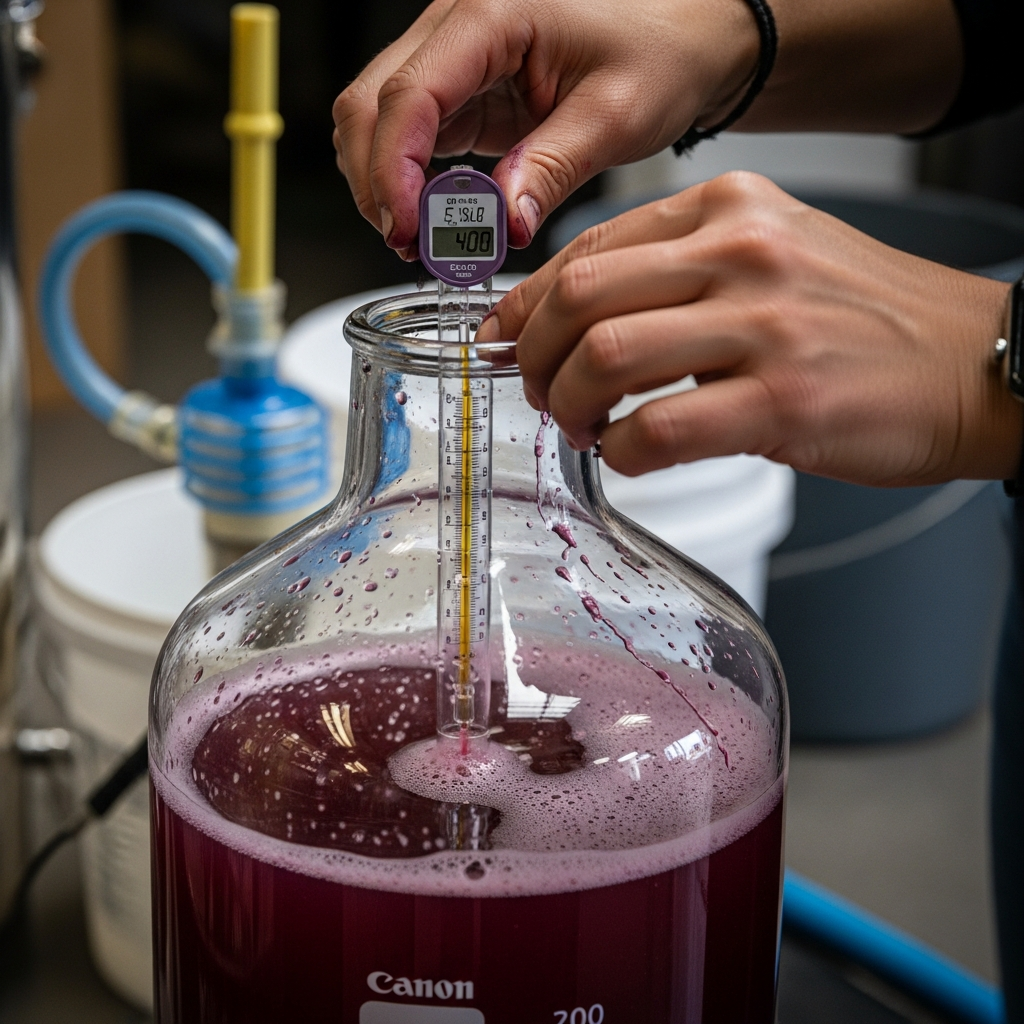
Here’s the test that rules out half of all “stuck” cases right away: take a hydrometer reading and look at your specific gravity. At or below 1.000? Fermentation is finished. Done. The wine is clearing, not stalling. A reading of 0.994 to 0.998 is completely normal for a dry wine that’s fully fermented out — that’s not a problem, that’s a success.
Still sitting above 1.010? Then yeah, you’ve got a genuinely stuck fermentation. The sections below cover every real cause, in a specific diagnostic order, so you’re not just guessing and hoping.
Take two readings 48 hours apart. Number doesn’t move at all — it’s stuck. Drops even a point or two — it’s just slow. Slow and stuck are not the same problem. They don’t get the same fix. Don’t treat them like they do.
Cause 1 — Temperature Drop
This is the most common cause, and honestly the most overlooked — probably because the fix feels too simple to be real. Wine yeast has a working temperature range. Most strains — Lalvin 71B, EC-1118, Red Star Côte des Blancs — want to be somewhere between 65°F and 75°F (18°C to 24°C). Drop below 60°F and they slow to almost nothing. Below 50°F, they just go dormant. They’re not dead. They’re waiting.
Basements are the classic culprit here. You start a batch in September when it’s a comfortable 68°F down there, and by mid-October it’s dropped to 54°F. The yeast doesn’t die — it just stops working. That’s actually good news, because it means the fix is genuinely straightforward.
How to Diagnose It
Stick a cheap aquarium thermometer on the side of your fermenter — the adhesive kind runs about $2 at any pet store or on Amazon. Read it at liquid level, not the top of the vessel. If your fermentation stalled after a cold snap or a sudden weather shift, temperature is almost certainly your culprit.
How to Fix It
Move the fermenter somewhere stable — a spare bathroom works surprisingly well, an interior closet is even better. Wrap it in a towel or slide a seedling heat mat underneath. The Vivosun 10″×20.75″ mat runs about $15 and handles one-gallon jugs and smaller carboys fine. For a 5-gallon carboy, step up to the 20″×20″ version.
Give it 24 to 48 hours after warming up. Most of the time, bubbling just resumes on its own — no new additions needed. If it hasn’t restarted within 48 hours of sitting at proper temperature, move on to Cause 2.
Cause 2 — Yeast Died or Never Started Properly
Yeast death happens. Not always your fault, either. Packets get stored too warm at the retailer. Must that’s still too hot when you pitch — above 95°F — kills most strains fast. Old yeast, skipped rehydration steps, yeast that just never took hold. All of it leads to the same silent fermenter.
Frustrated by zero activity after 72 hours of warming, I once dug out a packet of Lalvin EC-1118 I’d apparently stashed in a kitchen drawer for about 14 months. Expiration date had passed by a solid four months. That was the whole problem — not the wine, not the temperature, just an expired packet I hadn’t bothered to check. Don’t make my mistake.
How to Diagnose It
Check the expiration date on your original yeast packet first. Then walk back through your pitch — was the must cooler than 105°F when you added it? Did you rehydrate dry yeast in water between 104°F and 109°F for about 15 minutes beforehand, the way most manufacturers actually recommend? If any of that went sideways, the yeast probably never established properly.
How to Fix It
Repitch with a fresh, in-date packet. For restarts specifically, Lalvin EC-1118 is the industry standard — aggressive, alcohol-tolerant up to around 18%, and reliable in difficult conditions. A 5g packet runs about $1.50 at most homebrew shops. Rehydrate it in 104°F water with a small pinch of Go-Ferm, let it sit 20 minutes, then slowly acclimatize it to your must temperature before pitching. Don’t dump cold yeast directly into warm wine — that thermal shock does real damage.
Cause 3 — Nutrient Deficiency
This one is genuinely underserved in most winemaking guides, and it hits fruit wine makers especially hard. Grape juice is naturally loaded with the nitrogen compounds, vitamins, and minerals yeast need to stay healthy through a full fermentation. Most fruit wines aren’t anywhere close.
Peach wine is one of the worst offenders — low in yeast-assimilable nitrogen (YAN), stalls out around 1.030 to 1.020 even with healthy yeast at ideal temperatures. Blackberry stalls at the same range with annoying regularity. Elderflower wine, which is essentially sugar water infused with flower heads, has almost no inherent nutrients at all. Dandelion, apple, pear — similarly lean.
How to Diagnose It
If fermentation started strong, made it roughly halfway, then slowed or stopped — especially in one of the fruit wines listed above — nutrient deficiency is the likely explanation. Temperature’s fine, yeast is alive, but the yeast simply ran out of the fuel it needed to finish the job.
How to Fix It
Add yeast energizer — not just yeast nutrient, actual energizer, which contains diammonium phosphate, magnesium sulfate, and B vitamins that plain nutrient doesn’t. Fermaid-O and Fermaid-K by Lallemand are the go-to products for serious home winemakers. For a quicker fix, generic yeast energizer from most homebrew suppliers works fine and costs around $3 for a 1-oz packet. Add at roughly 1/2 teaspoon per gallon, stir well to degas the wine first, then wait 24 to 48 hours for the yeast to respond.
Cause 4 — Too Much Sugar at Start
This one is harder to fix — worth being upfront about that. When a must starts above a specific gravity of 1.120 (roughly 16% potential alcohol), yeast can lock up from osmotic pressure before fermentation really gets going. The high sugar concentration essentially pulls water out of the yeast cells. They’re dehydrated from the outside in before they’ve done much of anything.
Some winemakers who chase high-alcohol wines add sugar in deliberate stages to avoid exactly this. If you added it all at once and started above 1.120, you may have created a wine the yeast simply cannot finish. Fortified wines — ports, for instance — work around this by stopping fermentation intentionally and adding spirits. That’s not a flaw in the process; that’s the whole design.
Why This Is Hard to Fix
By the time you realize fermentation is stuck from sugar lock, the wine is already high in both alcohol and residual sugar. Pitching more yeast often doesn’t help — new yeast faces the same hostile osmotic environment. The most viable path is diluting with water or unsweetened juice to bring residual sugar down, then repitching EC-1118. Expect some flavor dilution. It’s an imperfect fix for an avoidable problem. Next time, start no higher than 1.110 and step-feed any additional sugar after active fermentation is already underway.
Cause 5 — CO2 Still Dissolved
Probably should have opened with this section, honestly. It catches beginners off guard more than almost anything else.
Active fermentation produces CO2 — that much everyone knows. During fermentation it exits through the airlock. But once primary fermentation ends, a significant amount of CO2 stays dissolved in the wine itself. It doesn’t leave just because fermentation stopped. The airlock goes quiet, the wine looks completely still, and it genuinely hasn’t stalled — it’s just done producing gas faster than it’s releasing the dissolved stuff.
How to Diagnose It
Take a hydrometer reading. At or below 1.000 — the wine is done, full stop. The “stuck fermentation” is dissolved gas behaving normally. You can confirm CO2 saturation by gently stirring — you’ll see fine bubbles rise to the surface, more than you’d expect from a truly still liquid.
This isn’t something to fix. It resolves on its own during bulk aging, or you can degas intentionally using a drill-mounted degassing whip — the FastFerment ones run about $12 — before you bottle.
Cause 6 — Campden Tablets Killed the Yeast
But what is the Campden tablet problem, exactly? In essence, it’s a timing issue. But it’s much more than that. Campden tablets — potassium metabisulfite — release sulfur dioxide when added to must. That SO2 kills wild yeast and bacteria before you pitch your commercial yeast. The problem is that SO2 doesn’t check credentials. It kills whatever yeast it contacts, wild or otherwise. Pitch too soon after adding Campden tablets and your commercial yeast lands in a chemically hostile environment before it can establish.
The standard waiting period is 24 hours minimum — 48 hours is safer, particularly in warmer must where SO2 dissipates more quickly. Skip that window and the yeast never had a real chance.
How to Fix It
Wait the full 48 hours from your last Campden addition before repitching anything. Stir the must vigorously once or twice during that period to help drive off residual SO2. Then pitch a fresh packet of EC-1118, properly rehydrated. One Campden tablet per gallon is the correct sanitization dose — using more doesn’t sanitize better, it just makes the sulfite problem worse and extends the waiting period you’ll need anyway.
How to Restart a Stuck Fermentation
Once you’ve identified the cause using the sections above, here’s the step-by-step restart protocol that works across most stuck fermentation situations.
- Take a hydrometer reading and record your current SG. Below 1.000 — stop. Fermentation is done, not stuck.
- Check and correct temperature. Get the must to 68°F–72°F and hold it there for a full 24 hours before doing anything else. A heat mat helps maintain that consistency overnight.
- Degas gently. Stir with a sanitized spoon to release dissolved CO2. This also adds a small amount of oxygen — actually helpful for yeast trying to restart.
- Add yeast energizer at 1/2 teaspoon per gallon. Stir it in well. Wait 30 minutes before the next step.
- Prepare a yeast starter. Rehydrate one packet of Lalvin EC-1118 in 104°F water with a small pinch of Go-Ferm. Let it sit 20 minutes — you’re looking for foaming or visible swelling before you proceed.
- Acclimatize the starter. Add a small amount of your stuck wine to the starter — roughly two tablespoons — every ten minutes for about 30 minutes. This bridges the temperature and alcohol gap so the yeast aren’t shocked on contact with your wine.
- Pitch the starter into your fermenter and stir gently to distribute.
- Check SG after 48 hours. Any drop at all — even a few points — means the restart worked. Keep monitoring every 24 hours until you hit your target gravity.
If fermentation still hasn’t restarted after 72 hours at proper temperature with fresh yeast and nutrient addition, go back and reconsider — you might be dealing with a high-sugar lock situation (Cause 4), or Campden residue that needs more time to off-gas before a second repitch attempt is even worth trying.
Stuck fermentations feel more alarming than they usually are. Most of them have simple, fixable causes. The difference between someone who loses a batch and someone who salvages it is almost always just the discipline to diagnose before acting — take the hydrometer reading, work through the causes in order, resist the urge to throw everything at the problem at once. Fix the thing that’s actually wrong.


Stay in the loop
Get the latest winemaker's friend updates delivered to your inbox.