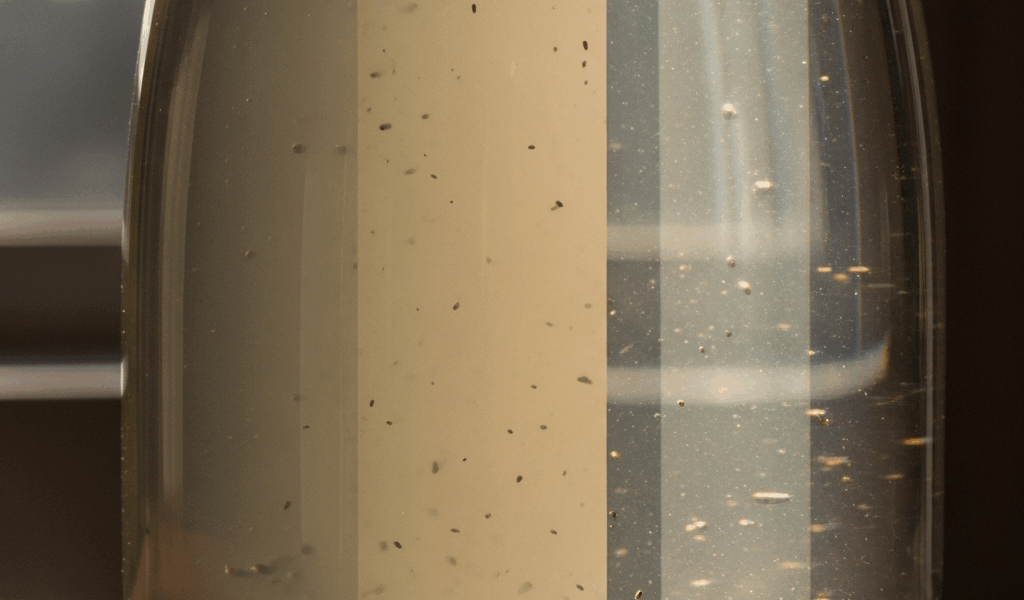
Why Your Wine Is Still Hazy After Weeks
Homemade winemaking has gotten complicated with all the conflicting advice flying around. You’ve waited. You’ve racked it twice. Maybe you’ve already thrown in some fining agent and crossed your fingers. Nothing worked.
Here’s what most clearing guides won’t tell you: not all haze is the same. Treating the wrong type fixes nothing. You could add bentonite to a pectin haze and burn two weeks for no reason. You could cold crash a bacterial infection and watch it persist anyway. The fix depends entirely on what’s actually suspended in your wine.
As someone who’s been making fruit wines for years, I learned everything there is to know about haze the hard way — after bottling a batch of elderberry wine that looked like cloudy apple juice. I’d thrown everything at it. Bentonite. Gelatin. Even isinglass. None of it worked, because I’d never actually identified what the haze was. Turns out it was pectin. One $8 bottle of pectic enzyme applied three months earlier would have solved the whole thing. Today, I will share it all with you.
Haze falls into a few main categories. Pectin (from fruit solids), protein (from grapes or yeast cell walls), suspended yeast that hasn’t dropped yet, and bacterial spoilage. Each one requires a different response. Skipping the diagnosis step wastes time and money. Worse, it makes you think your wine is ruined — when it’s probably fixable in a few days.
This guide walks you through identifying which haze you actually have, then gives you the exact fix for that type.
How to Figure Out What Type of Haze You Have
Before you buy anything or add anything, run three quick tests at home.
Test 1 — The Light Test
Hold a clear glass of your wine up to direct sunlight or a bright lamp. Look at the particles in suspension.
- Fine, uniform cloudiness (looks like milk) — usually protein or yeast
- Visible particles or flecks — likely pectin or starch
- Brown or rusty tint to the haze — possible bacterial infection or oxidation
- Cottony or stringy appearance — sometimes yeast, sometimes bacterial
Test 2 — Check Your Fermentation Timeline
When did fermentation end? How long ago?
- Finished less than 4 weeks ago — yeast is probably still in suspension. Cold crashing will help.
- Finished 2–3 months ago and still hazy — not just yeast anymore. Likely protein or pectin.
- You don’t remember — fair. Assume at least 6 weeks have passed, which means cold crashing alone won’t cut it.
Test 3 — What Was Your Starting Material?
This one matters more than people think.
- Made from fresh fruit (berries, apples, stone fruits, etc.) — pectin haze is a real possibility
- Made from grape juice or concentrate — protein haze is more common
- Very low alcohol wine (under 10%) — protein haze forms more readily in these
Test 4 — Taste and Smell
I know this sounds odd. Smell your wine anyway.
- Vinegar or nail polish remover smell — infection. Fining won’t save this.
- Normal fruit smell, no off-odors — safe to work with
- Sour or funky but not vinegary — warning sign, but often recoverable with proper fining
Probably should have opened with this section, honestly — catching bacterial spoilage early saves you hours of frustration and a carboy’s worth of wine you can’t get back.
Put It Together
Based on these tests, you can narrow down the haze type:
- Fine cloudiness + fruit wine + visible particles = pectin haze
- Fine cloudiness + grape juice or wine base + protein-prone conditions (low ABV, older wine) = protein haze
- Cloudiness + finished less than 1 month ago = yeast haze
- Brown tint or vinegar smell = bacterial spoilage (stop here; see end of article)
So, without further ado, let’s dive in.
Best Fix for Each Type of Haze
Pectin Haze — Use Pectic Enzyme
But what is pectin haze? In essence, it’s what happens when the natural polymers in fruit dissolve into your juice during crushing. But it’s much more than that — yeast eats the sugars during fermentation and leaves pectin completely untouched. Once fermentation ends, that pectin just hangs there.
The fix is pectic enzyme — also called pectinase. Brands like Lallemand Pectinex and Wyeast liquid pectinase work well. Dosage is typically 1/4 teaspoon per gallon, dissolved in a small amount of room-temperature water before it goes into your carboy.
Ideally, you add pectic enzyme before fermentation starts. It performs best in the warm environment of an active ferment. But even if fermentation is long done, it still helps. Give it 7–10 days at room temperature. The haze gradually settles. Rack once it’s cleared.
Cost is low — a bottle of liquid pectinase runs $12–$18 and treats multiple batches. Don’t make my mistake and skip this step with fruit wines.
Protein Haze — Bentonite Is Your Tool
Proteins suspended in wine create that fine, milk-like cloudiness. They come from yeast cell walls, grape skins, or unstable proteins already in the juice. Bentonite clay binds to protein particles and sinks to the bottom, dragging them down with it. That’s what makes bentonite endearing to us home winemakers — it’s cheap, it’s effective, and it’s been doing this job for decades.
Here’s the critical part. Most people add bentonite wrong. They dump it straight into the carboy and hope for the best. This creates clumps that take weeks to settle and can strip flavor from your wine in the process.
How to use bentonite correctly:
- Mix 1 teaspoon of bentonite powder with 1 cup of cool water. Let it sit for 15 minutes — it will swell and look like mud.
- Stir it vigorously for 2–3 minutes to break up clumps. It should look smooth, not chunky.
- Add this slurry to your carboy (1 gallon typically needs 1–2 teaspoons of dry bentonite).
- Stir your wine gently but thoroughly for about 1 minute.
- Wait 7–14 days without moving the carboy. Don’t rack or agitate.
- Bentonite settles to the bottom as a sediment layer. Rack off this sediment into a clean carboy.
Adding too much bentonite is a common mistake. More than 2 teaspoons per gallon can strip body and flavor from lighter wines. Start on the lower end — if the wine is still hazy after 14 days, rack it and repeat with a small additional dose.
Bentonite costs $8–$12 per pound online. A little goes a long way.
Yeast Haze — Cold Crashing First
If fermentation finished recently and the wine is still cloudy, yeast cells are probably still floating around in suspension. Cold crashing forces them to drop faster.
Move your carboy to the coldest place you have — a garage, basement, or wine fridge — and hold it between 50–55°F for 48–72 hours. Don’t let it freeze. After 3 days, rack off the sediment into a clean carboy.
This alone clears many yeast hazes. If it’s still slightly cloudy after cold crashing and racking, then move to bentonite. But give cold crashing its shot first. It’s free and it’s safe.
Bacterial Haze or Spoilage — Stop Fining
If your wine smells like vinegar, nail polish remover, or something you can’t quite name but know is wrong, you likely have a bacterial or wild yeast infection. Fining agents won’t fix this. The infection will persist or get worse.
Your options are limited. You can try stabilizing with potassium sorbate and sulfites — this may halt further spoilage, but it won’t clear the haze or rescue the flavor. More honestly? You may need to discard the batch.
This is rare with properly sanitized equipment. But it happens. Even experienced winemakers lose one occasionally — I’m apparently prone to it with elderberry, and StarSan works for me while other sanitizers never seem to do the job as well. Don’t beat yourself up over it.
How to Use Fining Agents Without Ruining the Wine
Fining agents work by binding to particles and pulling them out of solution. But they’re blunt instruments. Use too much and you’ll strip color, flavor, and body from your wine — sometimes permanently.
Here’s the step-by-step for the most common scenario: bentonite fining for protein haze.
- Prepare the bentonite slurry — this step prevents clumping, so don’t skip it.
- Check temperature — bentonite works best at room temperature, around 60–70°F. If your wine is cold, let it warm up slightly first.
- Add to carboy — pour the slurry in slowly while stirring gently. Don’t splash or aerate.
- Wait without disturbing — don’t move, shake, or rack for at least 7 days. Up to 14 days is better for stubborn hazes.
- Rack carefully — use a racking cane and siphon. Leave the bentonite layer on the bottom undisturbed.
- Second racking — optional, but 3–4 weeks after the first racking it can pull out any remaining fine particles and reduce the chance of re-haze.
Timeline expectation: 7–21 days from fining to a clear wine, depending on haze severity and which agent you used. Some wines need only 7 days. Stubborn ones take the full 3 weeks.
One mistake I see constantly — and made myself early on — adding fining agents to a wine that’s still actively fermenting. If your wine is still bubbling, wait. Fermentation will re-suspend the fining agent particles and you’ll waste the entire dose.
When to Stop Waiting and Bottle Anyway
At some point, you need to accept reality. You’ve run the diagnosis. You’ve applied the right fix. The wine is better but not crystal clear. Now what?
First: is the wine safe to drink? In almost all cases, yes. A small amount of haze is aesthetic, not a food safety issue. The exception is bacterial spoilage — and you’ll know, because the taste and smell will tell you clearly.
Second: understand the nature of fruit wines. Wines made with heavy fruit — elderberry, blackberry, stone fruits — often carry some permanent haze. This isn’t a flaw. It’s normal. Commercial winemakers accept it.
While you won’t need to achieve absolute clarity, you will need a handful of patience. First, you should wait 6–8 weeks after fining before making any final decisions — at least if you want an accurate read on where the wine is heading. Bentonite might be the best option for most hazes, as protein clarification requires consistent temperature and time. That is because bentonite’s binding action slows down significantly in cold or fluctuating environments.
If the wine is bright enough to read through after 6–8 weeks — even if not perfectly clear — bottle it. Wine continues to clear slowly in the bottle over months.
If it’s been 3+ months and multiple fining attempts haven’t moved the needle, make a decision. Accept it or discard it. Don’t let perfect be the enemy of good. A slightly hazy homemade wine tastes exactly as good as a clear one.
This new approach to diagnosing haze before treating it took off several years later among home winemaking communities and eventually evolved into the standard process enthusiasts know and swear by today. Two weeks for the fix to work, two more to settle completely, then bottle. Eight weeks total. If it’s not significantly clearer by week six, you’ve probably hit the limit of what that particular wine will achieve.
That’s when you bottle with confidence and start the next batch knowing exactly what you’ll do differently.




Stay in the loop
Get the latest winemaker's friend updates delivered to your inbox.