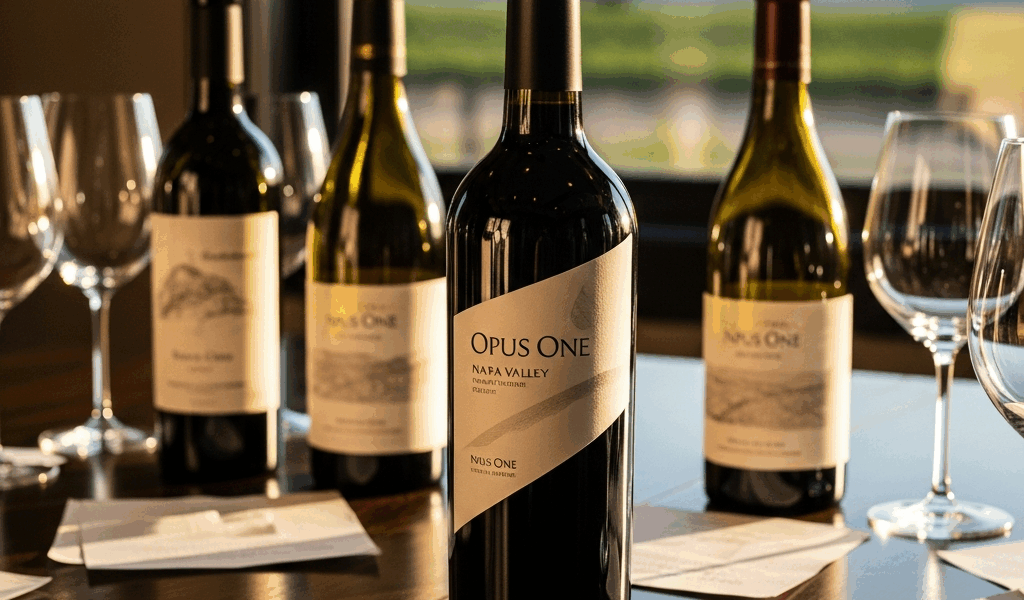
Is Opus One Worth the Price? An Honest Look at Napa’s Most Famous Wine
Opus One has gotten complicated with all the hype and reverence flying around.
It started at a wine shop in Yountville — close enough to the actual winery that a well-thrown cork might’ve reached the parking lot. I stood there staring at a $425 price tag, eventually bought it, and then grabbed a $160 Napa Cab from a producer most people couldn’t name. That Friday night, three friends and I — collectively responsible for opening probably a few hundred bottles of serious red wine — tasted them side by side. What followed was illuminating, humbling, and honestly pretty fun.
What You Get for $400
Let’s start with the liquid. It’s what actually matters and somehow gets buried in most Opus One coverage.
But what is Opus One? In essence, it’s a Bordeaux-style blend built around Napa Valley fruit. But it’s much more than that. Recent vintages run roughly 76% Cabernet Sauvignon, with the rest divided among Merlot, Cabernet Franc, Petit Verdot, and Malbec — those percentages shift depending on the harvest. The wine spends 18 months in new French oak. About 25,000 cases get made annually, which sounds generous until you factor in that demand is genuinely global and waiting lists at certain retailers are not a myth.
In the glass, it pours a deep, almost inky garnet. The nose opens with dark cassis, cedar — that unmistakable Napa Cab signature — black plum, and something I keep describing as violet pressed between the pages of an old book. No aggressive green or herbal edge anywhere. Give it 20 minutes and graphite shows up alongside dark chocolate. That’s where its Bordeaux ambitions start to feel earned.
The palate? Tannins that are genuinely polished. Not aggressive. This is not a wine that grips your cheeks and dares you to swallow. The finish is long, mineral, precise. It’s a very, very good wine. That part isn’t in question.
The backstory adds to the experience — and I’m not pretending otherwise. Frustrated by the widespread perception that California couldn’t produce a world-class wine, Robert Mondavi partnered in 1979 with Baron Philippe de Rothschild of Château Mouton Rothschild using a shared vision and two of the most famous names in 20th-century wine. This new idea took off several years later and eventually evolved into the estate enthusiasts know and celebrate today — the modernist building that genuinely looks like a spaceship landed in a vineyard, the underground cellar lit like a cathedral. Walking through that place affects how you taste the wine. Context is part of the product. That’s fine. That’s real.
Still. Four hundred and twenty-five dollars is four hundred and twenty-five dollars.
Why It Costs What It Costs
Probably should have opened with this section, honestly, because the price stops feeling so arbitrary once you understand what’s actually behind it.
Vineyard land in Oakville — the appellation where Opus One sits — trades somewhere between $300,000 and $500,000 per acre. Not the wine. The dirt. One acre of Cabernet Sauvignon in that location yields roughly 3 to 4 tons of fruit, translating to maybe 200 to 250 cases of wine. Do that math and the numbers start making an uncomfortable kind of sense before a single grape gets crushed.
New French oak barrels run $1,200 to $1,500 each. Opus One uses all new oak — one barrel per 25 cases, held for 18 months. Stack on top of that the labor, winemaking talent, a world-class tasting facility, and the distribution infrastructure needed to sell in 90 countries. An $80 to $100 production cost per bottle isn’t wild for a wine like this.
But here’s where I have to be straight with you: a meaningful slice of that $425 is brand, not liquid.
Opus One has lived on every nice steakhouse list in America for 40 years. It’s the bottle you order when you’re closing a deal on someone else’s expense account. It’s what you bring as a gift when you want to impress someone who knows nothing about wine but knows exactly what Opus One is. That positioning has real economic value — and you are paying for it. The famous names, the Rothschild association, the marketing weight of four decades — all of it folds into the price per bottle.
That’s not a scandal. It’s just how luxury goods work. A Rolex tells time no better than a $60 Seiko Prospex, but that’s never been the point of a Rolex. The honest question is whether you’re buying Opus One for the liquid or the story — and whether $425 makes sense given which one you actually want.
Wines That Taste as Good for Half the Price
This is the section I wish someone had handed me five years ago. Don’t make my mistake.
There are Napa Cabernets and Bordeaux-style blends that critics score within one or two points of Opus One — consistently, across multiple vintages — that retail between $100 and $200. I’ve tasted every bottle on this list. These are not consolation prizes. They are exceptional wines that most people, myself included, cannot reliably distinguish from Opus One in a blind tasting.
- Cain Five, Spring Mountain District — around $120 to $145. This is a Bordeaux blend from hillside vineyards above St. Helena, and it might be the most underrated wine in California. Deep, structured, earthy in a way that puts it closer to a Pauillac than most Napa wines ever manage. It scores consistently in the 93 to 96 point range. Most people outside serious wine circles have never heard of it. That anonymity is your advantage — use it.
- Dominus Estate, Yountville — around $175 to $200. Yes, this pushes the upper end of the range. Christian Moueix — the Pétrus family — makes this wine from Napanook Vineyard, and it is extraordinary. More restrained than Opus One, more savory, longer on the finish. Critics routinely land it at 95 to 98 points. In blind tastings, it regularly beats wines costing twice as much. Including Opus One.
- Spottswoode Estate Cabernet Sauvignon, St. Helena — around $150 to $175. Organically farmed, family-owned, and producing one of the most elegant Napa Cabs in the valley. The 2019 vintage received 97 points from Wine Advocate. Cedar, cassis, structural backbone — everything you’re paying for in Opus One at roughly 40% less money.
- Groth Reserve Cabernet Sauvignon, Oakville — around $100 to $125. This one is a genuine steal. Groth farms Oakville fruit — same appellation as Opus One — and the Reserve bottling consistently earns 93 to 95 points. If blind tasting were the Olympics, this wine would be collecting medals it never gets credit for.
- Château Léoville-Barton, Saint-Julien — around $80 to $120 depending on vintage. If you’re drawn to Opus One for its Bordeaux ambitions, just buy actual Bordeaux. Léoville-Barton is a Second Growth estate producing wine that tastes the way Opus One is trying to taste — structured, age-worthy, classically proportioned. The 2016 vintage is still available at many retailers around $90 and it outperforms most Napa wines at double the price.
Humbled by a blind tasting I organized at my apartment in 2021 — where neither I nor any of my guests correctly identified Opus One in a lineup of six wines — I stopped treating the label as a proxy for quality. That lesson cost me about $600 in wine and a fair amount of ego. That was 2021. I’m apparently a slow learner and Dominus works for me now while Opus One never quite justifies itself anymore.
The Verdict — Is It Worth It
Here’s the honest answer. No hedging.
Once? Yes. Buy a bottle of Opus One once — at least if you’re serious about understanding Napa at its most iconic. Open it on a significant occasion with people who’ll appreciate it, give it 30 minutes to breathe, pour it in a decent Bordeaux glass. A Riedel Veritas Cabernet runs about $35 a stem and is more than adequate. Enjoy the full thing: the wine, the story, the sense of tasting something historically significant. The craftsmanship is real. You will enjoy it.
But as a regular purchase — or as your benchmark for what great Napa Cabernet tastes like? No. The value simply isn’t there. For $425, you could buy two bottles of Dominus and one of Spottswoode, drink one of each over the next six months, and cellar the remaining Dominus for a decade. That’s a better use of four hundred dollars by almost any measure you care to apply.
The wines listed above — Dominus, Spottswoode, Cain Five especially — are not compromise choices. They are not “almost as good.” Several of them are wines I actively prefer to Opus One in terms of pure drinking pleasure. The difference is that nobody at a corporate dinner table recognizes the label. That matters to some people. To others, not remotely.
Opus One’s price is legitimate as a luxury product. As a claim about liquid quality relative to what else exists in that price neighborhood? Less so. The brand premium is real and it is substantial. If opening something iconic is what you’re buying, you’ll get it — fully, genuinely. If you’re buying it because you believe nothing else in that range tastes as good, several $150 bottles will correct that assumption fairly quickly.
Buy it once. Remember what it tastes like. Then spend your money on the wines that most Opus One drinkers have never tried. So, without further ado, go find a bottle of Cain Five and thank me later.

Stay in the loop
Get the latest winemaker's friend updates delivered to your inbox.